She Trusts Medicine. Estrogen Terrifies Her.
I was recently meeting with a friend who has also become a patient of mine, and we started talking about hormone therapy. She is not someone I would generally describe as afraid of medical treatments. She got the COVID vaccine almost immediately after it became available and was a very early adopter of a GLP-1 for weight loss.
But estrogen? She is terrified.
Specifically, she is convinced she is going to get a blood clot. And I do not think she is alone.
I have talked before about what happens when a patient tells me, "I know my body." I believe her. That still holds true, and I would never try to convince a patient to put something into her body that she is not comfortable with. But I also do not want fear based on outdated or incomplete information making that decision for her.
Not All Estrogen Is the Same
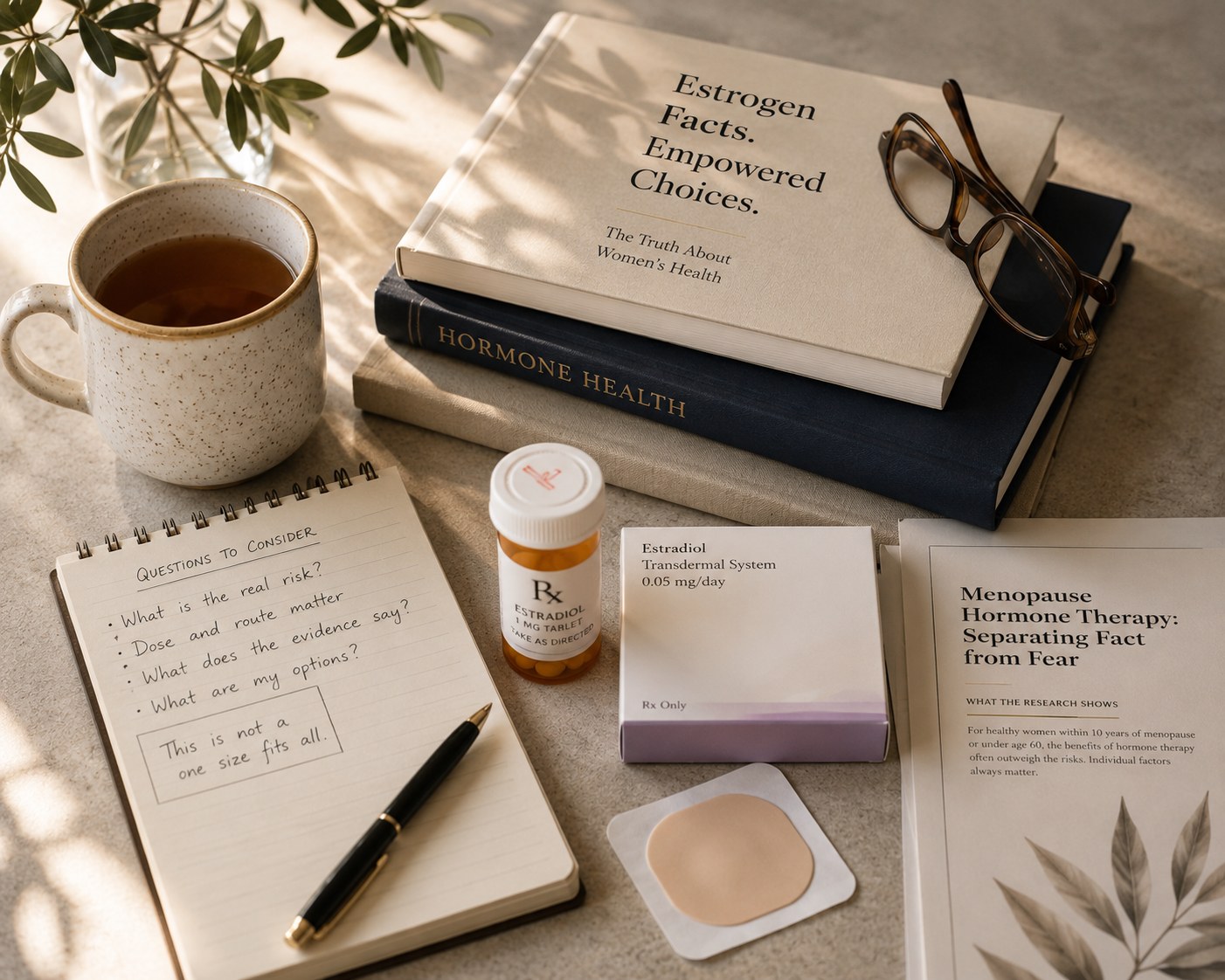
Hormone therapy is a perfect example. We tend to talk about "estrogen" as though it is one medication with one set of risks, when the type, dose and route all matter.
When it comes to blood clots, there is an important difference between oral estrogen and estradiol delivered through the skin, such as a patch. Oral estrogen goes through the liver first and can affect proteins involved in clotting. Transdermal estradiol bypasses that first pass effect.
A systematic review and meta-analysis found that oral estrogen was associated with an increased risk of venous thromboembolism, while non-oral estrogen was not associated with a statistically significant increased risk compared with women who were not using hormone therapy. For estrogen-only therapy, the odds ratio was 1.43 with oral estrogen and 0.95 with non-oral estrogen.
In other words, in that analysis, transdermal estrogen did not show an increased risk of blood clots compared with not taking estrogen.
That is a very different conversation than simply saying, "Estrogen causes blood clots."
Of course that does not mean hormone therapy is right for everyone. Your medical history, symptoms, personal risk factors, dose and route all matter. My job is not to convince you to take hormones. It is to give you accurate information about the risks and benefits so you can make an educated decision about your own body.
Maybe that is hormone therapy. Maybe you want to think about it. Maybe hormones are not appropriate for you or you simply do not want them. There are non-hormonal options we can discuss too.
You should never do something to your body that you are not comfortable with. But you deserve to make that choice based on good information, not fear.
Yes, You Can Come See Me
There is one other thing I want to address, because I have been asked about it a lot since announcing Axis. I have heard from friends, acquaintances, women I went to high school with and people I have not talked to in years asking some version of, "Is it okay if I come see you?"
Yes.
If you are comfortable with me being your physician, I am absolutely comfortable with you being my patient. You do not need to ask. I am excited to be practicing medicine again in my hometown and caring for women in my own community.
And everything about your care is confidential, including the fact that you are my patient. If we have mutual friends, I will not mention that you see me. I am not going home and telling my husband who I saw that day. Your care stays between you and me unless you choose to share it.
Where to Start
If you are wondering whether this is the right place for you, start with a complimentary 15-minute Discovery Call. This helps us make sure this is the right place for you. If it is not, no hard feelings, and I would still encourage you to follow along if you find this helpful. It is a conversation about how the practice works, not a medical visit.
You do not need to know whether you want hormones or have your plan figured out before you book. That is what our conversation is for.
I'm so glad you're here.
Dr. Caravelli
If you know a woman who has been quietly talking herself out of hormone therapy because of something she read or something she was told years ago, forward this to her. Send it to your sister, your friend, your mom, the woman who wants the real numbers before she decides anything.
Rovinski D, Ramos RB, Fighera TM, Casanova GK, Spritzer PM. Risk of venous thromboembolism events in postmenopausal women using oral versus non-oral hormone therapy: A systematic review and meta-analysis. Thrombosis Research. 2018;168:83–95.
This blog is for informational and educational purposes only and is not intended to be medical advice, diagnosis, or treatment. Reading this content does not establish a physician-patient relationship. Please consult your own physician or qualified healthcare provider regarding any questions or concerns about your health or treatment options. Never disregard professional medical advice or delay seeking care based on something you have read here.